

A Practical Guide to Reducing AI Inaccuracies in Your Work
A Practical Guide to Reducing AI Inaccuracies in Your Work
AI can write beautifully. It can structure arguments, summarise research, draft reports, and produce content that reads like it was written by a senior professional. But just because it is well written does not mean it is correct.
This is the core problem. AI is a people pleaser on steroids. It will always try to give you an answer, even when it does not have one.
Watch the full webinar:
The Problem is Bigger Than You Think
A recent study by the Institute for Public Relations in the USA found that inaccuracies from AI generated content was a concern for 97% of communicators surveyed.
That number should not surprise anyone who has spent real time working with these tools. What should concern you, however, is this: in a global study conducted by our very own Dr Karen Sutherland across the US, the UK and Australia surveying 400 professionals, 40% deemed fact checking AI generated content as only moderately important. Nearly half were not even editing or changing the information AI was generating before using it.
That is not an AI problem. That is an over-reliance problem. And it is already causing real damage.
It is Already Costing Organisations Real Money
In Australia, Deloitte was paid $440,000 to produce a government report. They had to return every cent because the report was littered with inaccurate references and AI generated misinformation. Similar cases have occurred in Canada and elsewhere.
When AI hallucinations make it into public-facing documents, reports, or communications, the consequences are not hypothetical. They are financial, reputational, and professional.
What Are AI Hallucinations?
AI hallucinations are outputs that appear fluent and correct but contain fabricated or inaccurate information. They happen for two reasons.
1. Vague Prompts
If your prompt is vague, your output will be vague. AI tries to guess the answer you want. When it does not have enough to work with, it fills in the gaps. Sometimes those gaps are filled with information that does not exist.
2. Training Data Issues
The model itself may have been trained on inaccurate or outdated information. That is the classic garbage in, garbage out problem, and you have no control over it.
The underlying issue is that generative AI tools were designed to prioritise providing a response over admitting uncertainty. They would rather give you a confident wrong answer than say "I don't know."
Beware of the articulate idiot.
Current Hallucination Rates
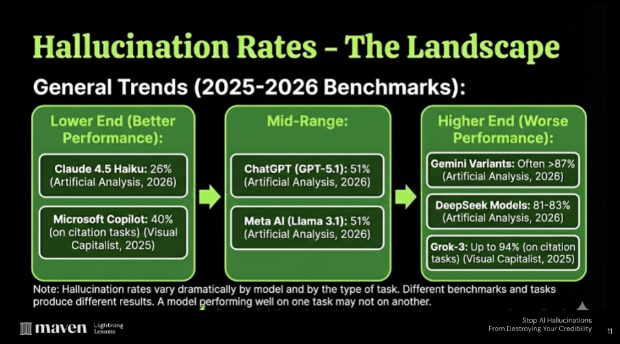
Hallucination rates vary significantly depending on the model, the task, and the complexity of what you are asking. They are not black and white. But as a general guide based on current benchmarks:
Best performers: Claude tends to perform very well. Microsoft Copilot has improved significantly from where it was a year ago.
Mid-range: ChatGPT and Meta models sit in the middle, depending on which model version you are using.
Higher hallucination rates: Gemini (particularly older models), DeepSeek, and Grok, though Grok performs well on certain specific tasks.
The key takeaway: it is getting better across the board, but no model is hallucination-free. You cannot rely on any AI tool 100%.
What the Latest Research Says
Researchers around the world are actively working to solve this problem. Here is what the latest findings show.
Clearer prompts produce better results. This has been tested in medical contexts and confirmed. The more specific and structured your prompt, the lower the hallucination rate.
Contextual documents reduce hallucinations significantly. When you give AI a specific document to work from and restrict it to that source, accuracy improves substantially compared to letting it draw on its general training data.
AI agents fact checking each other shows promise. In one study, AI agents were used to verify each other's outputs before delivering a response to the user. This reduced hallucinations by up to 75 to 80%. That technology is not widely available yet, but it is coming.
Predictive suppression is emerging. A breakthrough from last year involves AI models attempting to detect and suppress hallucinations before the output reaches the user. The AI is learning to correct itself in real time.
Progress is real. But we are not there yet.
A Three-Stage Process to Reduce Hallucinations
This is a practical framework you can apply to any AI content creation workflow. It covers what to do before, during, and after you generate content.
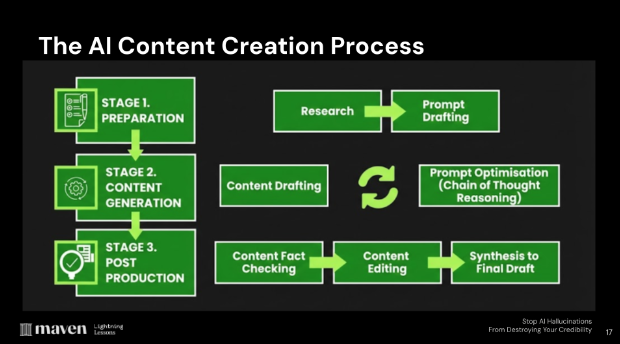
Stage 1: Preparation
This is where most hallucinations can be prevented.
Have an AI policy in place. If you are overseeing a team, make sure there are clear guidelines on what people should and should not do with AI. Train them in those processes. Prevention is always better than correction.
Supply contextual documents. Give the AI something specific to work from. A previous report, a brief, a style guide, a data set. When it has a quality source, it produces better results. Just be sure you are not uploading confidential information into tools that are not secure.
Draft your prompts before you start. Do not improvise. Write your prompts in advance. Give the AI a role. Tell it to be highly ethical and accurate. Set boundaries. If you have given it a document, tell it to only use that document and not to add external information.
Tell it the stakes. AI tool developers interviewed for Dr Karen's research said they always include a line at the end of their prompts: "The accuracy of this content is important to my career." Has it been empirically tested? No. Does it help? They say it does. It cannot hurt.
Stage 2: Generation
This is the back and forth process of refining the output.
Never accept the first output. Get the AI to review its own work. Ask it to review its analysis of the documents you uploaded and identify any inaccuracies. You would not use this as your only verification method, but AI can sometimes catch its own errors when prompted to look for them.
Ask it to isolate facts and figures. Get it to list every statistic, claim, and source separately so you can check them individually.
Ask for its reasoning. Tell it to show you the steps it took to arrive at its conclusion. With chain of thought reasoning now available in most models, you can see the logic path and identify where something has gone wrong.
Check every source it provides. Click through every link. AI still generates dead links and fabricated references. Cross-check with Google Scholar or the original source.
Stage 3: Post-Production
This is where you verify, edit, and finalise.
Cross-reference with original documents. If AI has pulled statistics or quotes from a document you provided, use the find function in the original to confirm they are accurate.
Verify citations manually. Even when using deep research features that return peer reviewed journal articles, always check Google Scholar to confirm the article actually exists.
Check dates and author credentials. AI can reference outdated sources or cite authors who are not credible in the relevant field.
Edit for brand voice and strategy alignment. Make sure the output aligns with your organisational strategy, brand voice, and communication objectives. Remove cliches, humanise the language, and check for bias, cultural sensitivity, and readability.
Why Human Oversight is Still Non-Negotiable
We are not at a stage where AI can be trusted to produce content without human review. It is getting closer, but the risk is still too high.
This is particularly important for less experienced team members. If someone cannot produce high quality content in a specific area without AI, they should not be using AI to produce it. They need to understand what good looks like before they can evaluate whether AI is delivering it.
New roles are already emerging in organisations. AI content verifiers and editors. That tells you everything about where the industry sees this heading.
Key Takeaways
Quality in, quality out. Your prompts and your contextual documents directly determine the quality of what you get back.
Have a formal process. Do not leave hallucination reduction to chance. Build it into your workflow at every stage.
Never rely on AI 100%. Even the best models hallucinate. Your oversight is what protects your credibility.
Beware of the articulate idiot. Well written does not mean correct.
Want to Learn How to Integrate AI Strategically?
If you want to go beyond individual tips and build a structured approach to AI integration, Dr Karen's ACE Certified AI Integration Sprint for Communication Leaders covers exactly this, including governance frameworks, tool evaluation, and a leadership-ready AI strategy you can present with confidence.
The next cohort starts Monday May 11.