

How to Create an AI Policy Your Team Will Actually Follow
How to Create an AI Policy Your Team Will Actually Follow
AI Governance for Your Business Without Killing Innovation
Artificial intelligence is already being used inside your business, whether you’ve approved it or not. Your staff are using it to draft emails, summarise reports, generate ideas, create content and automate admin. This is what’s known as Shadow AI and it’s happening in almost every organisation right now.
The real risk isn’t that your team is using AI. It’s that they’re using it without guardrails.
Watch Dr Karen’s live session on this topic.
Why Every Business Needs an AI Policy Now
Many leaders assume an AI policy is a “nice to have”, something to get to later, but the reality is far more urgent. Without governance, staff may be:
Uploading sensitive business data into public tools
Entering client or financial information into unsecured platforms
Publishing AI-generated content that hasn’t been verified
Making legal, financial or medical claims using unverified outputs
All of that introduces reputational, legal and compliance exposure. We’ve even seen cases where staff were uploading confidential information into free AI tools… while their organisation had a policy in place they simply didn’t know about. Sounds crazy?
Having a policy alone isn’t protection. Communication and training must sit alongside it.
The Problem With Most AI Policies
Most policies fail for three reasons. They’re either too vague and don’t define specific use cases. Other times they’re poorly communicated, and staff don’t know they exist. Or simply, they’re never enforced. No one owns them operationally. It’s just a policy sitting in a shared drive folder. That is not governance, it’s documentation theatre.
The Four Core Components of a Usable AI Policy
Let’s quickly go through a policy your team will actually follow. The policy must include four operational pillars.
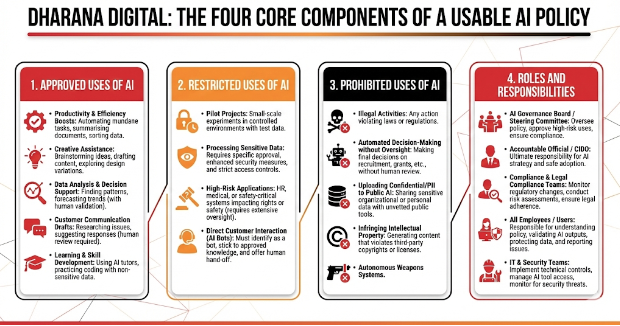
1. Approved Uses of AI - (and why verification matters more than ever)
This defines what staff can use AI for.
Typical approved use cases include:
Drafting first versions of content
Brainstorming ideas
Summarising research
Improving grammar and punctuation
Creating outlines or campaign structures
EVERY output must still be:
Fact-checked
Edited
Verified
Aligned to brand voice
AI should support work and not replace human accountability.
One of the biggest governance risks is over-trust in AI outputs. In Dr Karen’s research surveying hundreds of professionals, many admitted they only lightly edited AI content and viewed fact-checking as moderately important.
That’s where reputational damage begins. We often describe AI as an “articulate idiot.” It sounds intelligent, but that doesn’t make it accurate. Human verification must underpin every approved use case.
2. Restricted Uses of AI
Restricted uses require oversight or senior approval.These are typically tasks where messaging or accuracy carries greater consequence. Examples include:
Media releases
Official company statements
Sensitive stakeholder communications
Financial or health-related content
Communications that influence decision-making
In these cases, AI may assist drafting, but outputs must be reviewed, rewritten and approved before publication.
3. Prohibited Uses of AI
This is where organisations must be unequivocal. Under no circumstances should AI be used for:
Uploading confidential business data
Entering client or employee information
Legal or medical advice generation
Crisis communications
Content involving minors
Any material requiring verified factual precision
Clarity here protects your organisation. Ambiguity creates risk.
4. Roles and Responsibilities
Finally, the last pillar, roles and responsibilities. Policies fail when no one owns them. Operational governance requires defined roles.
AI Champion
Who is an AI Champion? An internal specialist who guides safe usage, answers team questions, reviews outputs, and promotes best practice.
Leaders & Managers
We better not forget about leaders and managers. They’re responsible for final approvals, risk escalation, and policy enforcement.
Team Members
Finally, all team members. They’re responsible for following approved use cases, avoiding prohibited uses, and of course, seeking approval when required.
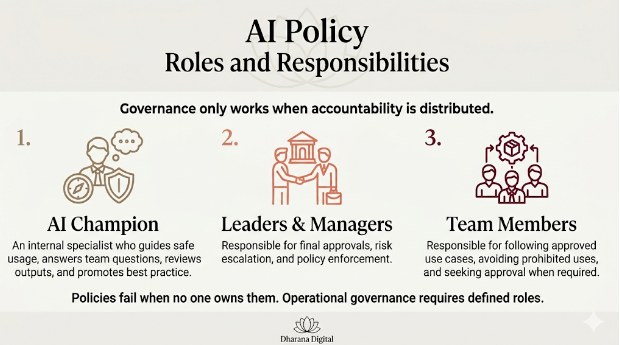
Remember, governance only works when accountability is distributed.
The Approved AI Tool List
This is one of the most critical yet overlooked components. Your AI policy should specify:
Which tools are approved
Which subscription tiers are required
Data privacy expectations
IT security alignment
Free tools often lack enterprise privacy protections and may train on user inputs, so tool selection is a governance decision, not just a productivity one.
Fact-Checking, Bias & Brand Protection
This one is a no-brainer. Even approved outputs require scrutiny. Your AI policy should require verification of factual accuracy, bias review, brand voice alignment, and most importantly, human editing before release.
AI should generate first drafts. Humans add what we call the “human sparkle.” Your final piece should have context and nuance.
How to Get Staff Buy-In
Now, this is a hard one. Policies imposed without consultation rarely succeed.
To increase AI adoption amongst your staff firstly you need to audit current AI usage. You must also involve teams in policy design and co-create use case definitions. Additionally you need to provide training and demonstrations, and you must explain the “why” behind restrictions. Governance really works best when it’s collaborative and not imposed.
Keep the Policy Alive
AI is evolving rapidly, so your policies must be reviewed regularly and updated as tools evolve. It is crucial that they are embedded in training and discussed openly across teams. AI governance isn’t a one-off document. It’s an ongoing operational discipline.
What Happens Without an AI Policy
Businesses without governance typically face data security exposure, compliance risk, reputational damage, staff confusion, and inefficient tool adoption, to name a few.
Let’s face it, it’s a pretty grim list. AI innovation without governance doesn’t create advantage, it creates vulnerability.
Ready to Build an AI Policy That Works?
If you want an AI policy that’s not just compliant but operationally usable, this is exactly the work Dr Karen supports organisations with, so your team can use AI confidently, safely and strategically.
Together, you develop:
Approved, restricted and prohibited use frameworks
Tool governance structures
Fact-checking protocols
Staff training plans
AI champion models
Policy communication rollouts
Book a Strategy Session
If you’d like support developing or refining your AI policy, you can book a time with Dr Karen.
In this session, you’ll identify your current AI risk exposure, immediate governance gaps, policy priorities, training requirements, and finally, implementation of next steps.
AI usage is already happening inside your business. The question is whether it’s governed… or not.