

AI for Lead Generation: Four Ways to Speed Up Finding Your Next Client
A Practical Guide for Business Owners and Communicators
Lead generation can be one of the toughest things to do in business. If you are a sole trader, or you have a very small team, it is tough and it is unavoidable. You have to keep doing that business development to bring in new leads, new clients and new customers.
You need prospects in the pipeline just in case some of the clients you have decide to move on. It depends on what you sell. With a service business doing mainly project work, you need that constant supply. Retainer clients are great, although if you do not have enough of them, and one of the larger ones moves on, it can really impact your business when there is nobody else to follow up with.
The good news? There are AI agents that can automate this entire process for you.
Where It Actually Gets Hard
When we asked the question where lead generation hurts most, the answers landed in a few predictable places.
Finding people who are actually a fit
Sometimes you get plenty of leads in, and none of them are aligned with your business. Working that out can be a real waste of time, particularly when it only becomes obvious after several meetings and you reach the final crunch before realising there was never a fit.
Knowing what to say first
Writing an opening message that sounds like a person rather than a template is its own skill. We all get those DMs. Most of them are cringe.
Turning an enquiry into a client
That is a skill in itself, and plenty of good communicators are not natural salespeople. Our own view of it has shifted over time. Sales has a really bad reputation, when really it is about listening to the customer's needs and seeing if you can assist them. You are not pushing anything on anyone. You are helping them find a solution.
Finding the time for any of it
Time is the real issue. For example, for Dr Karen, Dharana Digital runs alongside a full-time academic role, so much of her work happens on weekends. Finding new clients with those hours available is challenging, which is exactly why these shortcuts matter.
The Golden Rule
AI does the legwork. You stay in charge of the whole thing.
You can automate the entire process with agents. Even then, you want to be the person overseeing it, because AI gets things wrong and what goes out represents your business. Everything that reaches a prospective client should be the quality you would expect from an employee doing that work on your behalf.
In practice that means three habits. Check the prospects it recommends. Read every message properly instead of copying and pasting it straight into a DM. Confirm that any information you share is accurate, that your pricing is right, and that you have permission to use it.
Some people read that and think, well, obviously. You would be surprised. Dr Karen’s research into AI adoption shows a staggering number of people relying on AI blindly. The tools are getting better, and they still make mistakes. Coming from a public relations background, she is vigilant about professional reputation, and what you put out there has to protect yours.
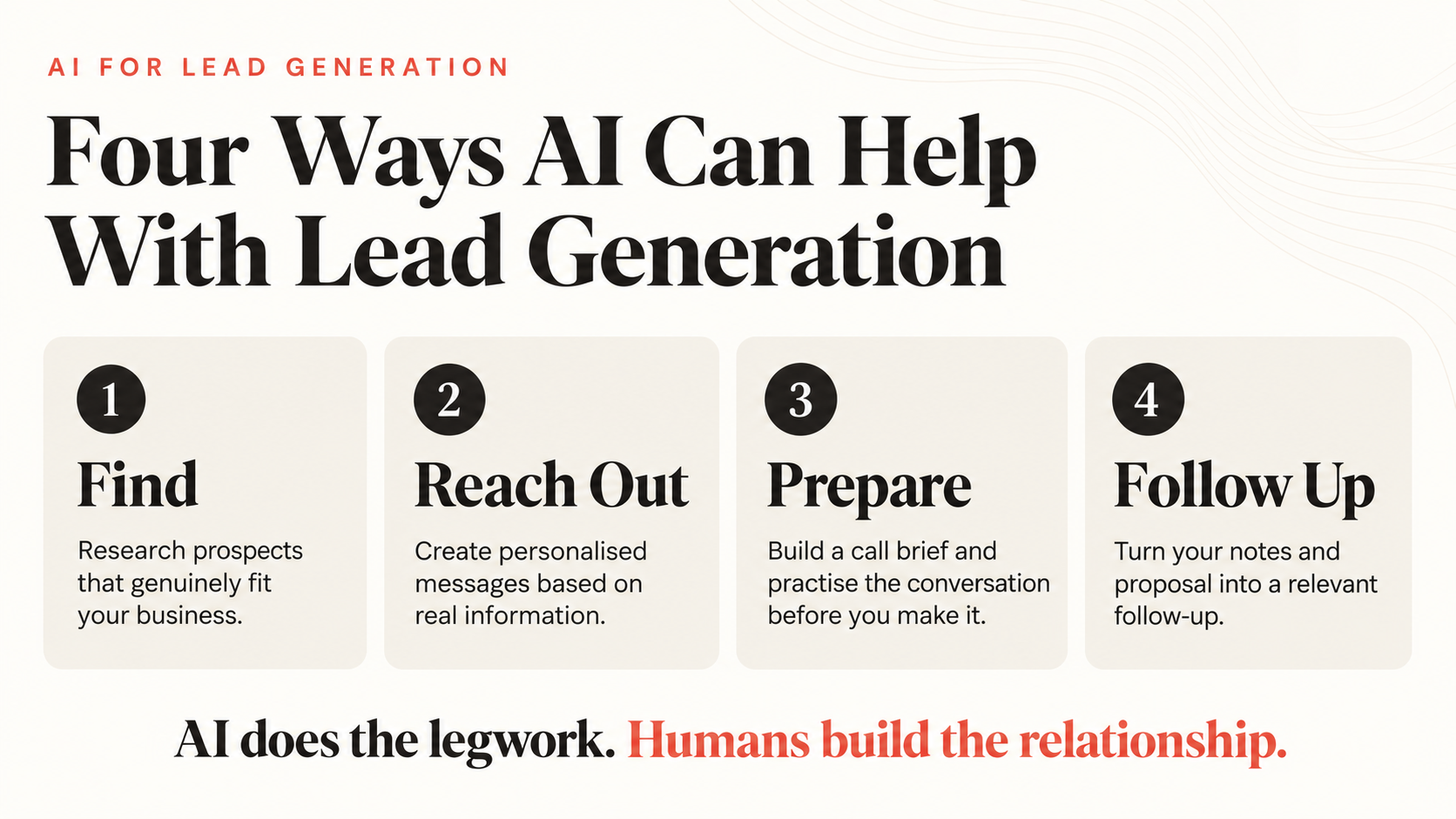
Step One: Researching Prospects With Manus
Manus is excellent at going off, searching the internet and bringing things back, which makes it the right tool for building a prospect list. It takes a while to run, so start this one first and check back later.
There are four things to get right before you send it off.
Describe your business. What you sell, and who it actually helps.
Set the search criteria. Location, type of business, and any exclusions. You would not include other digital marketing agencies in our list, because they would be doing this work themselves.
Ask for evidence. Source links and page URLs, so you can check everything it claims.
Vet the shortlist. Go through it carefully before anyone hears from you.
The prompt
I run [business name]. We offer [service] to [customer]. Find up to five independent [business type] in [location] that may be relevant prospects for this service. Exclude competitors and chains. Inspect their public websites, look for specific opportunities relevant to my service and give examples. Return a table with the business and website, fit with my criteria, a specific observation and page URL, possible relevance to my service, and the public business contact page. Label possible needs as inferences. Do not invent contact details.
What came back
Our search was for website projects, run on Dharana Digital as the business. Manus returned a table of local businesses, including Foreshore Property Services, all sitting in the same sort of category.
The useful part was the column on information missing from their pages. Manus had effectively audited each website, which gave us specific, real observations to use in an outreach message rather than generic flattery. The table came back formatted exactly as requested.
Doing that yourself would take a couple of hours. This took minutes. You still need to be discerning about who you contact, so vet the list first rather than casting the net wide.
Watch the demonstrations
Watch the full webinar recording below, where Dr Karen runs all three demos live, including a sales call rehearsal in ChatGPT voice mode that was very much an experiment on the day:
Now that you have seen them in action, here is what the other two tools do for you.
Step Two: Writing Outreach With Claude
With a vetted list in hand, it is time to reach out. We used Claude for this, with our existing messaging fed in so the drafts sound like us.
Four things make the difference here.
Pick one prospect. Specific beats generic every time.
Explain the offer and the relationship. What you can genuinely deliver, and whether you have met this person before.
Add your voice. Paste in previous branded emails so it picks up the feel rather than producing robotic text.
Draft and refine. AI is a first draft generator. You add the human sparkle before anything goes out.
Watch for messages that are not helpful or respectful, and for bold claims. AI can go overboard, so make sure what you send is legitimate.
The prompt
Help me draft outreach for my business offering [service]. My offer and what I can genuinely deliver is [details]. Prospect information: [details]. Our relationship is [never met, already connected, and so on]. My writing examples are [paste previous emails]. Write two alternatives, a LinkedIn direct message and an Instagram or Facebook business DM. These are alternatives, not a plan to contact them on both. Keep each under 80 words. Identify me and my business. Connect one verified observation to a possible benefit, and end with an easy question. Be respectful, do not invent problems, do not promise more sales or rankings, and only offer a next step.
What came back
Our demonstration used a fictional business called Coastal Garden Care. Claude drafted both messages and counted the words as it went, which is a genuine improvement. It could never count before.
The LinkedIn version read:
Hi Alex, Karen from Dharana Digital here. We design and develop websites for small businesses so customers can see what's on offer and enquire easily. I notice your homepage lists end of lease garden tidy ups, while your service page covers maintenance and hedge trimming. A short outline of what a tidy up includes could help customers know what to expect. Would you be open to a 15-minute introductory call?
That works because of one line in the middle. It found something real on his website and pointed at it. The usual version of this message praises the business in vague terms and asks for a call. This one earns the ask.
The revision prompt
You can edit the draft yourself, or hand the polishing back to AI:
Revise the [LinkedIn message]. Make it sound closer to my writing examples. Remove generic praise, sales jargon, or any claim. Keep one clear reason for contacting the business and one easy question. Do not imply they need a new website.
On the day it barely changed anything, which told us the first draft was already close. That is a useful signal in itself.
Step Three: Preparing the Brief Call
ChatGPT handled the last part of the process, which covers three jobs: the call brief, the rehearsal, and the proposal follow-up.
The call brief
Help me prepare for a 15-minute discovery call for [business] about [service]. Prospect information and their enquiry: [details]. My service details and boundaries are [details]. Give me a short call brief with what we know, what we still need to ask, four open questions about their goals, two concerns they might raise, and a sensible next step. Do not invent facts, prices or commitments.
What comes back is a solid script. What we know, what still needs asking, the open questions, the likely objections and where to take it next.
The rehearsal
This part was the experiment. Using voice mode, we asked ChatGPT to play the prospect and ran a 90-second mock call.
Play a small business owner considering website work from [business]. You want clear information about the services but are unsure whether a rebuild is necessary, and worry about the cost and the time needed to supply content. Raise a concern and wait for my answer. Keep your responses short.
Alex raised three things in 90 seconds: whether the site needed a rebuild or just updates, whether costs would blow out, and how much time he would have to spend writing content himself. Those are the real objections, and hearing them out loud is different to reading them on a page.
Afterwards we asked for a critique. The feedback was specific. Starting with an audit rather than jumping to a rebuild was smart. Framing the cost as step by step handled that concern well. The time objection was handled strongly by showing that we do the heavy lifting. Where it pushed back was on the filler phrases, on answering the rebuild question more directly before drifting into rankings, and on tightening the close.
Questions worth asking after your own rehearsal:
Did I ask enough to answer the customer's needs?
Did I explain the value without making promises?
Voice mode has become useful well beyond sales calls. We use it for learning languages and for practising difficult conversations. If the sales process makes you nervous, this is a low-stakes way to get the reps in.
Step Four: The proposal follow-up
This is the one everyone needs. You have the meeting, they ask for a proposal, you send it, and then crickets.
Draft a proposal follow-up for my business. Call notes: [what you discussed]. Date sent: [date]. Writing example: [paste one]. Write a warm, direct email under 150 words in UK English. Refer to their stated priority, explain one relevant item, and address any unresolved concern.
What came back was brief and specific, opening by thanking Alex for his time and naming his actual priority of making the gardening services clearer. ChatGPT also offered to connect to Gmail and send it, which is precisely the point at which you take over.
What Still Needs You
AI gives you the first draft and the legwork. You bring the judgement. Here is what still needs a human:
Every prospect on the list, checked before anyone hears from you
Every message, read properly rather than copied and pasted
Pricing, claims and any information you do not have permission to share
The call itself, and the relationship that comes out of it
People buy from people. Nobody is buying from an AI avatar, or an AI voice on the phone. A few might, and most want to trust the person they are buying from. That part is still yours. What AI does is get you ready for it.
One unexpected benefit: it builds confidence. You can tap into generative AI's knowledge base around sales, and if you know specific sales experts by name, you can ask it to bring their thinking into your preparation.
Key Takeaways
Use an agent like Manus to research prospects, and insist on source links so you can verify what it finds
Ask it to audit prospect websites, so your outreach can point at something real
Feed your own previous emails into Claude so the drafts sound like your brand rather than a template
Cap outreach messages at 80 words, one observation, one easy question
Build a call brief before every discovery call, including the concerns they are likely to raise
Rehearse the call in ChatGPT voice mode, then ask for a critique
Keep a proposal follow-up prompt ready, so silence after a proposal never costs you the work
Vet everything. What goes out represents your business
Which part of your lead generation process would you hand over first?
Start with one step. That is all it takes to see the difference. We would love to hear how you are using AI across your own lead generation.
If you want support integrating AI strategically into your business, here are some ways we can help:
Join Dr Karen's AI Integration Sprint - helping senior leaders do the strategy work to integrate AI into their teams, certified by the AI Centre of Excellence.
Come along to our next free webinar, AI for Message Testing, on 27 October, where we look at how strategic communication professionals are testing messages with synthetic target audiences before they go out.
Join our free Facebook community - where we share different AI tools and articles, and go live every Friday afternoon talking about what has happened in AI this week.
Book a chat with Dr Karen - let's talk about how AI can work for your specific situation.
Because AI adoption without strategy creates noise. AI adoption with structure creates advantage.